
A way to describe the end state of something we have read, once it’s stored in our head? Also, a word for the fallacy of imagining that we end up with perfectly shared knowledge after reading the same thing?
This Alex Norris comic feels like a perfect representation of both these questions in my mind.
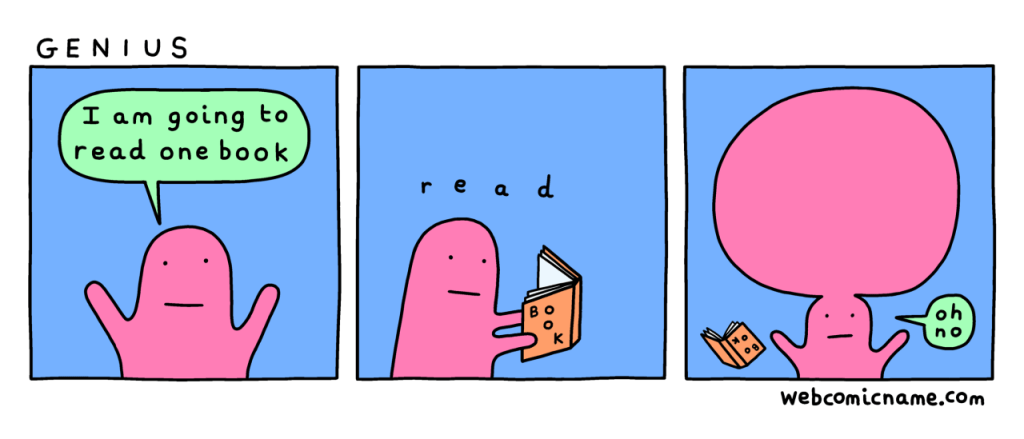
Oh No person has taken the information in, but what form does it take inside their individual head? (Or is this comic more about the curse of knowledge?)
I’ve been asking these questions for a while and it’s felt like a clumsy thing to ask. And possibly not much clearer now I’ve written it down, but I think this is due to there not being a word for it yet. It’s in that tricky place of being a concept that is conceivable, yet elusive without a name.
Like how I imagine schadenfreude existed wordlessly in British culture for generations before we borrowed the German word for it. Before then, I expect people felt oddly conflicted by their tingles of joy when witnessing a bad thing happening to someone else. Or, maybe they never even noticed.
All this said, there could very well be words for these things and I just don’t know them yet. If that’s the case and you know then please share them with me!
The only rough description or word that comes close to the concept for me is ‘mentalese’. The hypothesis that there is a language of thought.
I first learned about this decades ago in Steven Pinker’s book The Language Instinct, and it’s likely fuelling a large part of my enormous intrigue in this area still. And spilling over into my fascination with aphantasia as a variation to mentalese and how the mind works – which happens to be another Pinker book that’s embedded in my brain.
Right there though. Case in point. How exactly are these two Pinker books stored in my mind? Not verbatim. Far from it. But culturally, when we say we’ve read things we accept and project the illusion that we somehow contain ‘the book’, rather than the truth which is surely just a slight echo and conceptual blob of the book. Cherrypicked highlights that aligned with our personality and bias.
And what about another reader of either of those books? Would they assume we know the exact same things seeing that we’ve read the exact same book?
And what about you? On a smaller scale than a book, but finishing this now. What do you take away and would that be shared exactly with someone else that said they read it?
To some extent it feels obvious to say, when asked, that of course we don’t interpret the exact same things. But I wager that most of the time we unconsciously assume that we do. When we read a book, or an article, or a call for tender, or a project brief.
We read things and naively carry on, like we’re on the exact same page, when really the pages in our minds are great big and invisible screwed up jumbled blobs of interpretation, sitting precariously on top of our heads.

 Mathew Wilson – Documenteering