
This advice was given to an amateur photographer by Noah Kalina, a professional photographer whose work I’ve followed for years. The giving of this advice, 7 years ago (around 2017), was retold by the amateur in a ‘hotline call-in show’ which Noah has been making since the start of 2024.
In summary (and in more detail below), Noah had recently learned about aphantasia and realised that he essentially has it, putting himself at 4 on this scale…
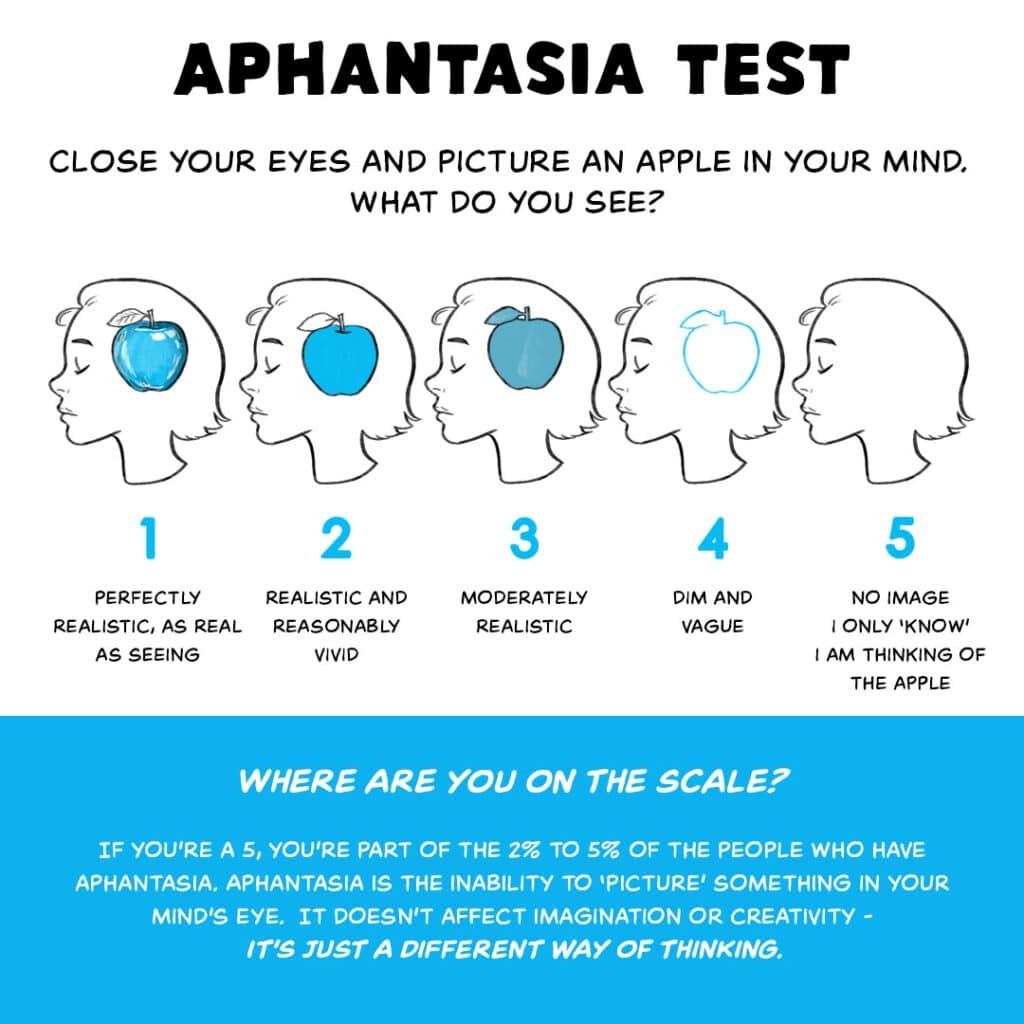
And I think the amateur, Brad, was calling in with his own realisation that the advice therefore might not have been all that good. Or at least, that he and Noah were not ‘seeing mind’s eye to mind’s eye’, as it were.
Here’s a link to The Hotline Show V, at the point where Brad, begins his question, and explains that the previous show’s mention of aphantasia prompted him to call in.
Embedded here also (at 19min 47sec)…
And here’s the crux of what Brad recalls about when he reached out online for advice about…
…how to overcome seeing an image in your head and not being able to capture it. And your reply to me was, “It will never be how you see it. It should be better”… what you told me all those years ago, kind of still makes me think twice before I press the shutter button.
To which Noah replies…
That sounds like something I would say. And I’m probably saying that because in my mind, I don’t see much. I just see grey. So anything that I have in my mind when I photograph it, it will just naturally be better.
Noah then goes onto mention a friend who sees very vivid mental images – 1 on the scale – and explains how the friend says…
…that that actually is a detriment to his practice. Because he has something in his head that is so clear, and when he goes out and tries to make somethings it’s never as good as what he imagined. And, I thought that was pretty powerful and I certainly don’t relate to it because whatever’s in my head I know when I go out that it’s going to be better because what’s in my head really is nothing.
He goes on to acknowledge, and almost recognises (as I do) that Brad is likely also 1 or 2 on the scale, and that maybe it was bad advice to give, but doesn’t quite get there.
I did though. And it’s stuck with me like an earworm since February, because it’s such a strong example of how poorly we understand each other. How impossible it is to be truly empathetic to everyone we talk with, and how often our communication is likely being misinterpreted due to our unique cognitive processing.
I think this when it too comes to talking about design ideas, or explaining to someone how something works, or when giving or receiving advice about productivity and time management methods.
We have all these kinds of conversations with enormous assumptions that our brains are processing the details and potential mental images in the same way, yet the aphantasia scale alone shows the potential for us being enormously misaligned.
The reason I think this example stuck with me so much is that I’m a de-saturated 1 on the aphantasia scale. I’m like Noah’s friend. I can see incredibly detailed 3D mental images, that I can manipulate and zoom in and around and out of with ease. And also like Noah’s friend, I’ve found it often to be a detriment to my practice as a designer and image creator. Nothing ever looks as good as it does in my mind. And so advice like “It will never be as good as you see it. It should be better”, is unachievable and highly unhelpful.
Misalignments with statements and pieces of advice like these are an invisible barrier to successful communication and collaboration, and I really want to smoke more of them out.
Note. If Noah looks familiar, it’s likely because of his everyday project.
 Mathew Wilson – Documenteering