
I’m late to this lovely looking illustrated Olympic Sports Explained feature from Reuters and immediately interpret the first page on Archery as accurate and good information. I know nothing about Archery, but this is Reuters, and so surely right.
Out of interest, I wanted to see how they illustrated BMX (choose cycling from the ‘choose a sport’ navigation) because that’s my old sport and something I know a fair bit about. Here’s the image, which I wager you, dear reader, if you don’t know BMX, will trust as much as I do the Archery illustration…
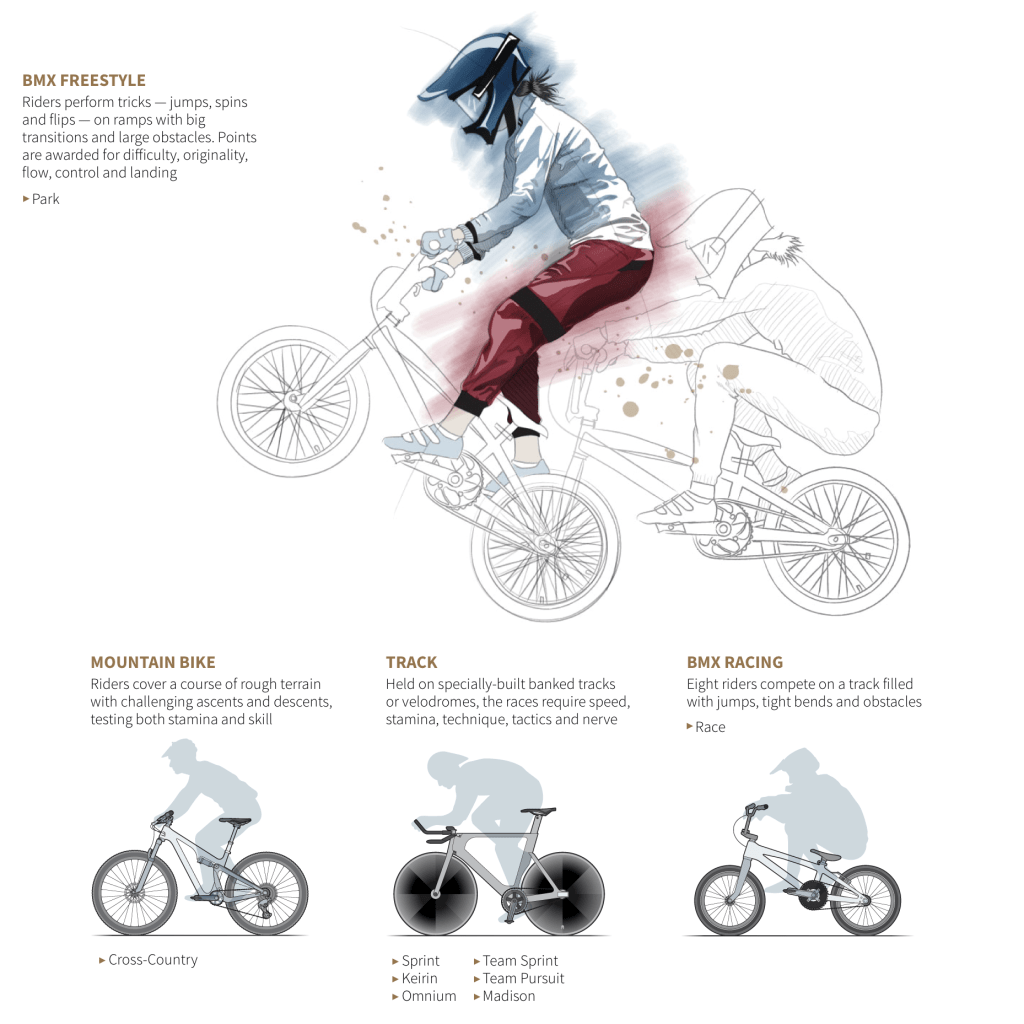
Well, you shouldn’t because it’s a really inaccurate representation of a BMX freestyle/park/street rider. The bike has the wrong geometry, the wrong type of saddle, and if it were to be of a typical modern park bike, then it shouldn’t have a break (a detail of street and park riders that wasn’t at all common in the 90s when I rode a lot, that I still find fascinatingly brave).
And the rider looks to be wearing clipless pedals (no way any BMXers other than racers wear them), race trousers, and a full face race helmet with goggles, where skate helmets are by far the most used by park riders ) and never ever worn with googles.
In fact, if you look closer at the BMX Racing illustration, you can see it’s basically the same rider and bike, for which it is fairly accurate. They just used the same BMX, because, a BMX is a BMX, no? No.
BUT, then I navigate to Fencing or Equestrian which I know nothing about, and go back to assuming it’s all good and accurate info.
The Murray Gell-Mann Amnesia effect (a topic I’ve touched on a few times in the past) is strong with this one, and making me wonder yet again how this isn’t a more popular of studied cognitive weakness.
 Mathew Wilson – Documenteering