
A little while back I found principles.adactio.com and designmanifestos.org. Great collections of design principles and manifestos that I’ve been meaning to link to and share.
Every time I tried though, the post would get longer and longer, and I would get more and more ranty. I tried a number of times to edit my thoughts down, and a few times even deleting and just posting the links on their own without context, but I can’t quite resist. So, I’m going to indulge the rant in attempt to exorcise the niggles, and see where they lead.
These then are my thoughts, observations and grievances with design principles and manifestos. It’s a bit of a mess. Very opinionated. And could do with a ton of editing, and even more evidence and data to back them up, but for now, here’s the spiel.
Same difference
To begin, I think they’re practically the same thing, or at least, two sides of the same intent. Principles are more corporate perhaps, and manifestos maybe more rebellious, but generally they’re both (supposed to be) strongly held fundamental beliefs that guide a design practice. In the remainder of this piece I’ll mostly use ‘principles’ and save excessive repetition of both.
Put your money where you mouth is
Personally, and perhaps controversially (as you may have guessed by now), I’m generally a sceptic of principles and manifestos being things that designers pore over extensively. It seems that there’s more effort given to theorising and talking about these topics, than tangible outputs proving what they mean. In short, I see a lot of principles becoming flexible when that’s what’s needed to keep stakeholders happy.
This is what drove me to collect my own set for a while. Soft evidence gathering, to see if I could align my feelings and arguments about how insincere and inconsistent they seem to be in practice.
My main argument though is best summed up in the belief that…
A principle isn’t a principle until it costs you money.
Which – I learned via Nick Asbury – was said by advertising legend Bill Bernbach. (I’d also highly recommend Nicks book on ‘purpose’, which overlaps with and encourages a lot of what I express here).
Saying the same old things
Further more, my feeling is that the majority of design principles end up as matryoshka doll-like ways of saying the same thing. Slightly varying levels of detail and turns of phrase, but basically on the same few themes. Synonyms dressed up as original concepts.
And even when there are claims that a set of principles is unique, or in some way worth loudly expressing and promoting as something new, it’s likely that they’re still relatable to the Dieter Rams ‘ten principles for good design’. Even if derived in isolation of them.
Semantics, semantics, semantics
A lot of this also goes back to my main squeaky wheel messaging about semantics, and people simply not sharing the same understandings as each other, while pretending that they do. Take for example the criticism I’ve seen (that I annoyingly can’t find to link to), that Dieter’s principles don’t cover accessibility and inclusion – as we are rightly more focussed on today.
I’d argue though that caring deeply that all user groups are included in design considerations, is thoroughly contained within Dieter’s: point 2. Good design makes a product useful, point 4. Good design makes a product understandable, point 8. Good design is thorough down to the last detail, and point 10, Good design is as little design as possible.
It’s all about interpretation, and from all I’ve seen, principles and manifestos are mostly just re-interpreted and non-attributed versions of the same old ideas. We’re just playing language games and wasting a lot of time by trying to constantly reinvent and pour over them.
Note. I don’t mean that Dieter’s principles are all we need, and that no one should ever discuss anything else.
The opinion I’m sharing, specifically about lists of design principles is that if you really want to gather your list and put them on a flag or a /principles URL slug, that you start by looking at what’s already out there, rather than acting like you’re treading uncharted territory and coming up with revolutionary ideas. And if you feel you are, be clear about what you’re rebelling against and what exactly came before.
Don’t just default to ‘principles’
I think these thoughts and feelings are why I like the angle that Public Digital has taken with their positions page (and lack of a /principles page). Yes, there’s still a sprinkling of semantic smoke and mirrors between ‘principle’ and ‘position’, but for me ‘a position’ is more active and less abstract. It’s more about action than lofty aspiration. Harder too to misinterpret, or reinterpret, when needed.
That said, I can still see threads between the PD positions and Dieter’s principles, most notably, Position 8. Honesty is a valuable asset vs. Principle 6. Good design is honest. But again, it’s a language game, and a case of trying to understand each other openly, which I feel these positions do better than most lists of poetic principles. At least, they feel more genuine, considered and actionable than most /principles pages I’ve seen.
OK. I’m being a bit pedantic (and maybe a bit obtuse)
Getting into my ranty stride now… Another thing that really winds me up 😅, is when lists of ‘principles’ – from the Latin ‘principium’, meaning a beginning or foundation, and derived from the root ‘princeps’, meaning first or chief – become enormously long and impractically foundational.
The best/worst case of this is the book Universal Principles of Design, Third Edition, by William Lidwell, Kritina Holden and Jill Butler (see a PDF of earlier version here). I was so fascinated by it I felt compelled to buy a copy…
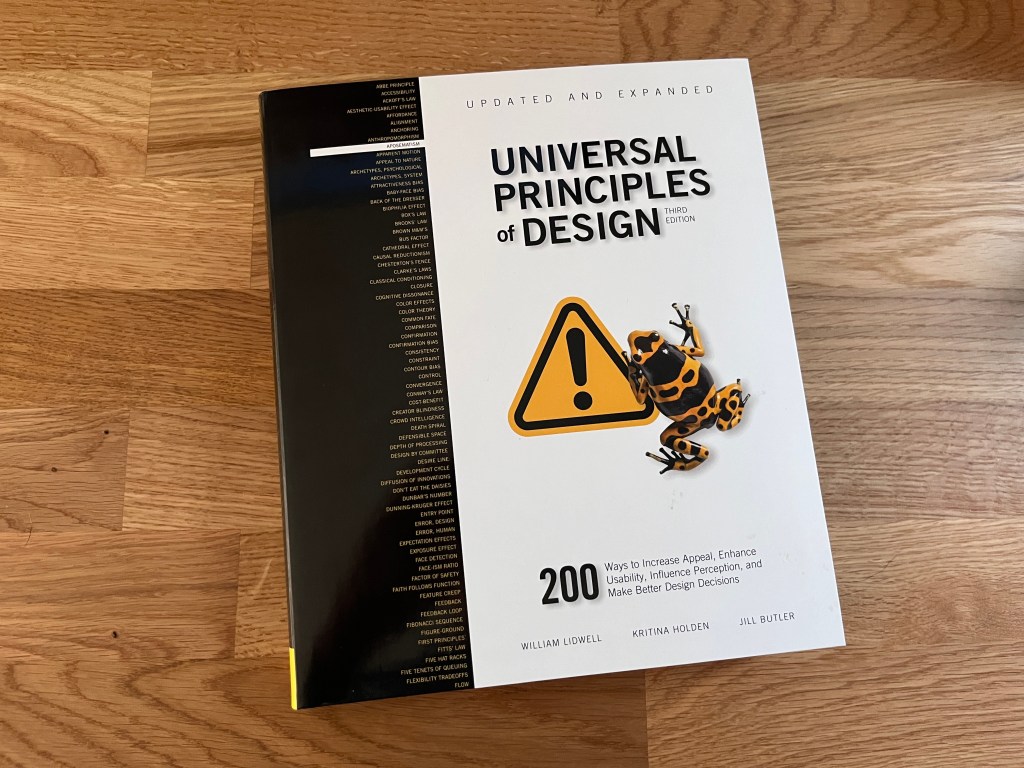
That’s 200 ‘principles’. 200 things to think about ‘first’. Forget seven, plus or minus two, here are 200 concepts that you need to begin with.
The use of the word ‘principles’ in this case is just bonkers, and illustrative of how nonsensical and broad the word has become. And that’s a great shame, because the book is full of utterly fascinating ideas (200 of them!).
I don’t think we should be calling them ‘principles’ of design though. They’re really good ideas. Replicable examples and lessons. Fantastic observations. And as much about human psychology as design (which is something we need more conscious consideration of in design).
Being more honest about how they’re applied
Perhaps then, my main issue with ‘principles’ is just a pedantic semantic belief about the word, as I feel that a principle should be absolute. Fundamental. To call something your design manifesto or a principle means it should be an immovable condition of how you work.
When you point to a manifesto or set of principles, you should be saying that this short collection of ideas, beliefs, passions – and fundamental principles to how we operate in everything that we do – is where we stand, and will not budge from.
If your manifesto or principles are abstract or fluffy therefore, and especially if at times you have to let them go a bit, and turn away from them for commercial purposes, then don’t call them manifestos or principles. They’re just hopes or aspirations. Not capital P Principles, or all caps MANIFESTOS! And that’s fine. In fact, it’s great, because it’s realistic, honest, more practical, and adaptable.
Remember, ‘a principle isn’t a principle until it costs you money’. So if you’re not willing to take a financial hit in order to live up to your highfalutin rhetoric, then don’t state it so officially. Instead, have aspirations, set goals, state your aim, or positions, that you can actually work toward.
What do you think you’re doing?
What’s my point in all this? What action am I recommending? What’s really behind my rant here?
I think this is all wrapped up in a phrase that’s been ringing louder in my internal monologue over the last 3 or 4 years: ‘What do you think you’re doing?’.
It comes with multiple intonations, such as angry, provocative, generally exacerbated, genuinely curious, encouragingly inquisitive, and excitedly explorative.
It’s like a super-powered way of asking why, more than five times. A more engaged and provocative version of questioning. It feels almost like the start of a manifesto… But really, I think it’s more just part of an old strategy (an idea that I’m not trying to dress up as original): To question everything.
It’s a hard nudge, to engage more in ‘System 2 design thinking’, and spend less time defaulting to System 1, heuristics, theatre, and ritual in our design practices.
Maybe I’m picking on principles and manifestos too hard then. Perhaps my issues with them are just symptoms. Me, dealing with the issue that my internal monologue is being triggered by. So what’s that?
A belief that we need to be more honest, conscious, pragmatic, and progressive in our actions, rather than just listing 4 words like those, calling them principles, and then carrying on regardless.
Mostly it’s just semantics though. Isn’t it
It is. I’ve definitely got a dominant pedantic streak when it comes to language and meaning. But that’s literally how we understand each other, which is important, so I’m running with it.
 Mathew Wilson – Documenteering