
A busy few weeks away from a computer. Or any screen for that matter. Which was nice. Hence also how much more I’ve listened to rather than read. But also good to be back at a desk today.
Read
An energy efficient home – why is it so difficult?
Good to see the insulation issue getting attention. Yes, heat pump excitement is exciting, but most homes need insulation first, and that’s even harder to figure out and find service providers for than heat pump installation. The whole industry is suffering from service design issues.
In my, lateral, opinion, we should be investing money in education and the training of service providers, and teaching them about service design principles, rather than boiler upgrade schemes. The trades that can do this work need more support in understanding the service opportunities out there. It would surely result in more services like ecofurb.com, mentioned in this article. That’s the help I (and I wager a lot of others) need, before we bother plumbers with random inquiries and site visits that mostly reveal unsuitable insulation issues.
I’m aware I’m a bit ranty on this, but I really do feel like I wasted the time of the upgrade scheme registered plumber that came to my house, only to discover it would be an inefficient and expensive heat pump installation. While Insulate Britain have got the issue right, I do fear their techniques have caused more harm that good in making people aware.
Threads: You do have to accept all three of these at the same time… Benedict Evans
I’m always looking for perspectives on how to reconcile the negatives and positives of people. Erin shared this one he’d seen with me.
The meaning of “AI”. Jeremy Keith
A great piece on the confusion and semantics of terms we use in tech. “It’s almost as if the labelling of the current technologies was more about marketing than accuracy.” That, yes, but as much also about ‘trial behaviour and laziness’.
Bluesky: We pay too much attention to the most confident voices—and too little attention to the most thoughtful ones. Adam Grant
Agreed. And exactly why I’m still loving the Quiet Posers feed on Bluesky. I’ve found some great points via this that I would have missed under the ‘confident noise’ that gets to the top the ‘Discover’ and ‘Following’ feeds. It still has me wondering how we might force quiet people to say more things!?
What’s the impact of artificial intelligence on energy demand?
“First, the International Energy Agency (IEA) recently published its landmark World Energy Outlook 2024 report. It suggests that energy demand for data centres and AI will still be pretty small for the next five years at least. I read it as them saying: “Everyone just needs to chill out a bit.” But in a more diplomatic way.” A good addition to AI reading right now, specifically relating to environmental impact. Still not conclusive, but it feels like it adds some needed balance to all the effective guessing and estimating.
Listen
Sheryl Cababa – Systems Thinking for Designers, with Andy Polaine
So much resonates in this conversation between Sheryl and Andy. I always felt that systems-like thinking was a default part of design. Or ‘design thinking’. Realising over the past few years though that this isn’t quite the case. Which feels a little embarrassing to be honest. To be fair on myself, I blame my old amazing partners and colleagues! Mostly technical folk, and all very smart, their defaults all seemed very systems like, and based on finding patterns and efficiencies.
Thanks to Erin, With Associates was a Ruby on Rails agency, almost from its inception. Both actually began in 2004. And RoR feels essentially like applied systems thinking in software development. Then there was the vigorous accessibility standards focus and HTML/CSS best practice of Jenifer. Effectively championing the view that websites were part of the wider web, and the browsers evolving alongside it. Part of a larger ecosystem, open to as many people as possible, and designed to last as long as possible. Everyone we employed thereafter shared these ideas, and we all acted like they were the norm. Obvious. No?
To put it more kindly then, I should say that due to being surrounded by systems thinkers for so long, I was lucky enough that it became a default part of my own design practice and thinking. Still, I can’t escape the slightly sad feeling that this systems view of design isn’t the norm. Which makes me even more grateful of people like Sheryl for trying to change that. I need to get her book, Closing the Loop (the cover of which resonates further still, with a period when I really got into paper size standards and realised my love for ISO 216 and the related systems and interconnect nature of it… and how far far superior it was to the terrible US letter paper size!).
Sal Khan says AI won’t destroy education — but there’s a catch
I’ve got a lot of respect for Sal Khan and what he’s created in Khan Academy, so it interesting to hear his views on, and active involvement in AI. I actually use AI myself in the way he describes that he’d like to see it used in education. Less a tool for writing things for me, much more a way to interact with topics, ask for my ideas to be challenged, and as a way to engage more actively in learning. Not just reading and internalising. I learned here also of khanmigo.ai – Khan Academy’s first experimental venture into AI assisted learning. I’d love to try it as a parent when it’s available in the UK. Speaking of parents – I also like ideas in this episode about using AI to help with parental settings. Managing two nearly needs, across iPhone, iPad and Mac, even with the integrated parental settings UI, is getting really tough to do well. Some assistant help in this respect would be awesome.
How to Succeed at Failing, Part 3: Grit vs. Quit. Freakonomics
“The politics of the university are so intense because the stakes are so low”. This quote jumped out. Its origin is confused but the sentiment feels like it holds, no matter where it came from. Also know as Sayre’s law. It has a similar truism feel to ‘science makes progress funeral by funeral’. More broadly, this series is interesting as a whole, although for a 4 part series, I’m surprised I didn’t come away with more insight.
Busting the myths of the brain with neuroscientist Chantel Prat. Re: Thinking with Adam Grant
More great chat about differences in cognitive processing, understanding and semantics. In fact, there was lot’s that caught my attention in this episode.
In particular, at 12min 16sec, Adam mentions how his friends young child called ankles ‘leg wrists’ before they knew the correct word. And then the apparently viral case of a child calling tears ‘panic water’. I love both of these.
Reminds me of a conversation I once had with an Austrian who knew very little English (although far more than I knew German). They were trying to describe how someone now looked much older, but they couldn’t find the word, and “the years have not been kind to their face” came out. So poetic. As per leg ankles and panic tears. All fuel to my fire that some (if not all) of the best creativity comes from restrictions and the simple combination of tangible concepts.
Later, at 26min 12sec, in response to the question ‘What’s your favourite, surprising fact about the brain?’, Chantel says “when you feel curious, your brain is squirting out dopamine, which helps it to rewire and learn in the face of what you experience next.” Love this description, but also the clear statement about curiosity causing dopamine to squirt. Feels very accurate to my dyslexic+ADHD brain.
In response, ‘the curiosity gap’ and ‘knowing-doing gaps’ are mentioned, with the latter feeling like something I should have known (a knowing-forgetting gap maybe). This has big overlaps with my fondness of ideas like unknown unknowns, the Johari window, pluralistic ignorance, and many more.
And finally, at 37min 25sec, Chantel says what I think is either the mic drop moment of the whole conversation, or a succinct manifesto for my own investigations into collaborative working neurodiverse teams…
“I think we are becoming increasingly aware that having different perspectives, having diverse perspectives at the decision-making table is valuable and important. But yet, we still feel more comfortable with another brain that makes the same decisions that we do… We want all of these different brains in our collective problem-solving space. And so the, the work to be done is like, how do we understand and appreciate them?”.
Listen/Watch
What no one wants to admit about comic book sales. Mattt
Another great video essay from Mattt. I learned lots from this about Scholastic graphic novels which gives me more hope about the children’s literacy subject I’ve liked to before. I had no idea Scholastic made up so much of comic sales (despite how many Dogman etc books my kids have). This video nudges my feelings about Books vs. Comics vs. Audiobooks vs. Video vs. ‘Content’ also. Too much focus on and division between medium isn’t helping the spread of stories and ideas. It made me think of the Reithianism aim to ‘educate, inform and entertain’. That’s what ‘content’ and content creation is about.
Look
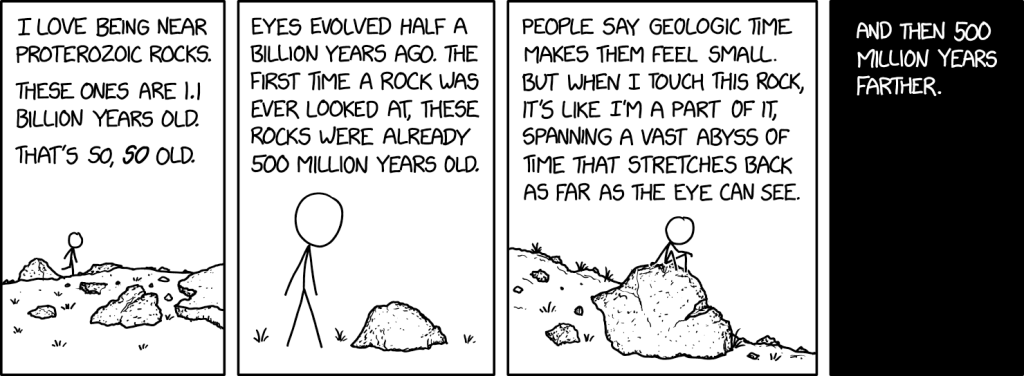
Proterozoic Rocks. xkcd
“Eyes evolved half a billion years ago. The first time a rock was ever looked at, these rocks were already 500 million years old. People say geologic time makes them feel small. But when I touch this rock, it’s like i’m a part of it, spanning a vast abyss of time that stretches back as far as the eye can see. And then 500 million years farther.” The most enlightening and beautiful xkcd ever? Possibly.
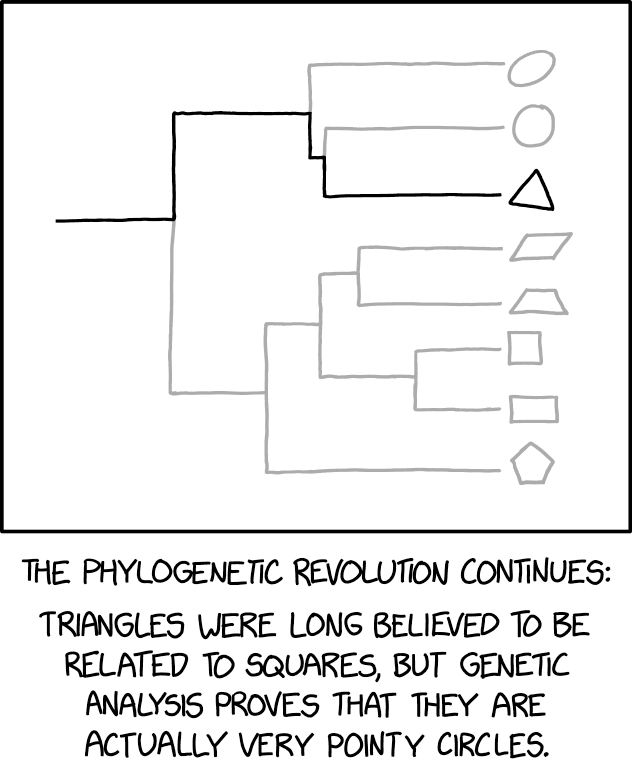
Geometriphylogenetics. xkcd
“Triangles were long believed to be related to squares, but genetic analysis proves that they are actually very pointy circles.” Sometimes, his ideas are just so simple, but so good, it’s maddening!
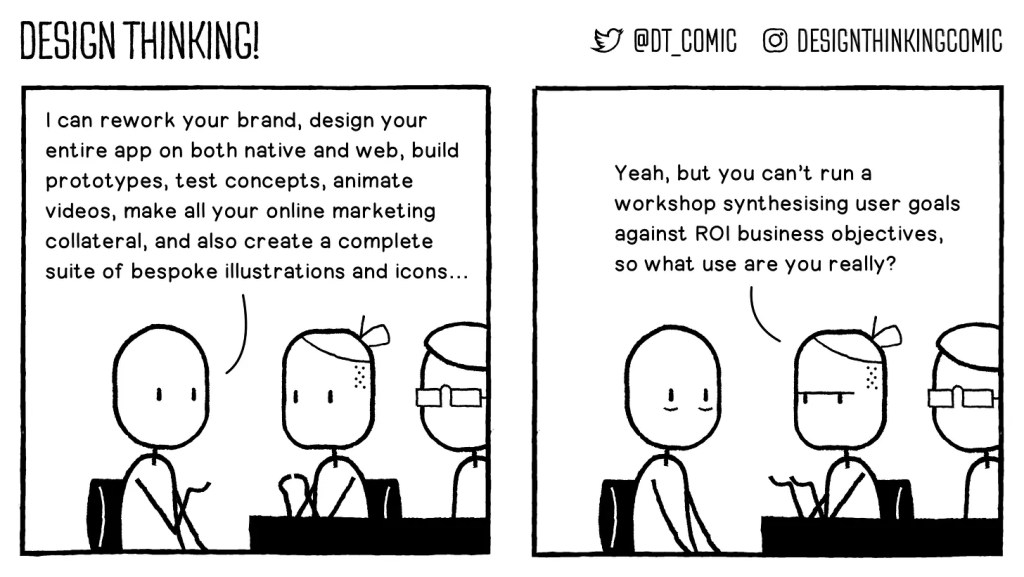
Know your worthlessness. DESIGN THINKING!
Roles, responsibilities, outputs, objectives, tasks, titles, value, buzz, outcomes, and performance.
1 dataset 100 visualizations
“Can we come up with 100 visualizations from one simple dataset?”. Yes they can. Lovely, even if at times a bit silly stuff, by the impressive looking Ferdio
Ordino
“Business Tools for Creatives, by Creatives.” One to watch.
Want
Book: A More Beautiful Question by Warren Berger
The Power of Inquiry to Spark Breakthrough Ideas. Looks and sounds like a great book that’s very inline with my approach to design. Reading is is sadly not in line with my already too big book stack though.
Think
/junk page
I love ideas for standardised website pages on personal sites. Taylor gives a guide to the /junk page idea, and elsewhere on his site links to this writeup about the /now page idea. And I’ve Linked before too aboutideasnow.com. I want to create all of these on mathewwilson.me, as well as my own ideas for /influences (where I would like to catalogue the things I feel have a most influenced me and my way of thinking) and /recommendations (where I want to host my own endorsements and reviews). One day. Too many projects.
Today’s problems come from yesterday’s "solutions.” Peter Senge
This has been ringing in my head a lot for a while now. Getting louder also it feels. Wonder what’s that about. Or what it’s brewing?
 Mathew Wilson – Documenteering