
Follow
A new section for my interesting collections. Coming after feeling particularly grateful for people that share things I wouldn’t have otherwise found. It’s a delightful experience that reminds me of ‘the old web’. When humans were the glue that held it all together. When folk with maven and connector type qualities would somehow find, then share and ignite ideas and interests in others. Here are just four, at front of my grateful mind. I’ve given each an arrow symbol [↗ ↖ ↙and ↘] to indicate the links they led me to, though there have been many before.
↗ Ash Mann – Digital expertise for cultural organisations.
I was fortunate enough to meet Ash at Substrakt while I was working with The Bridge Theatre. He’s recently gone solo in consulting and shares one of the most thoughtfully curated digital / cultural / creative newsletters I know. A lovely weekly mix that’s quickly becoming somehitng I look forward to. Always more than a few things in there that I’ve not yet come across. Examples below marked with a ↗ symbol.
↖ Join [Iain and his] 900+ subscribers who love clear language.
I’ve mentioned and rejected from this more than once before now, but pulling it up here for a proper credit. Composed by the lovely Iain Broome. A brilliant weekly nudge of resources to keep you thinking about the creation of accessible content.
↙ Emily Webbers Posts from Awesome Folks.
I struggle to imagine how Emily manages to be so well read and productive, but she does, and there’s a lot to be grateful for in that. I’ll admit to actually unsubscribing for a little while as I felt I couldn’t quite keep up! The pace of things she shared that I wanted to read into more deeply got a bit too much for my hyper leaning brain. Giving it another go now, alongside other attempts to address signal vs noise.
↘ kottke.org – Home of fine hypertext products since 1998.
I think Jason Kottke has been the most influential maven, connector and sales person of my adult life. To think of the things I would never have seen or learnt if it were not for him is not a nice thought. Such a great service to the intent and all broadly creative and curious minds. Tim Berners-Lee should give him some sort of World Wide Web knighthood.
Read
Good UCD is boring magic. Pleasing, but boring enough to move on from.
I keep coming back to the idea of ‘boring magic’. It’s known well in some circles, but I think it’s worth more than being an in-joke that we nod in humorous agreement to. A salient reminder of what UCD people should aim for. But, even more importantly I think, it’s a brilliantly concise phrasing to remind us of what we’re trying to sell to clients, and how boring and skeptical they must feel about it!
↙ Book: The Social Brain.
“A unique blend of evolutionary psychology and strategic leadership insights, perfect for anyone interested in working in thriving groups.” Found via Emily Webber so instantly took the recommendation and downloaded it. Oh my days, vvv good. It’s correlating with so many experiences, theories, thoughts and beliefs! All in a ‘good confirmation bias’ way, I think…
Artificial Intelligence Playbook for the UK Government.
On first read… this seems really sensible. It would make a good “Should I use AI” decisions making flowchart, with almost every flow ending up at ‘No’! Which is likely a good thing. A bit like xkcd.com/2267. There’s always an xkcd.
The Hidden Structures of ‘Choose Your Own Adventure’ Books.
Searching for a particular flowchart meme for the above post, I stumbled on this instead. Cool to see these adventure books mapped like this. I always imagined authors would effectively write them this way. Hit me also how navigating big projects always feels like a CYOA. Could be interesting to map out the path a project took, alongside imagined possibilities with different events or decisions being made. Kick-off goes well, or terribly. Client team changes completely, or remains consistent. Key stakeholder leaves, or more join in. A D&G like project retro exercise. From the article: "One analysis found that more than 75 percent of the endings are unfavourable or deadly”. Again, feels applicable to some projects!

Extensive graphical analysis of CYOA books.
Down the rabbit hole of Choose Your Own Adventure books now, and found this in-depth exploration by Christian Swinehart. I’m sure I remember this from 2009 when he first posted it. I’ve not read the whole thing, but including it here as even just scanning this page is an inspirational joy. Brilliant stuff.
↗ The Anti-SNARF (Stakes/Novelty/Anger/Retention/Fear) Manifesto.
“It turns out when an app company doesn’t care about content and asks an AI to maximize usage the result is a service that incentivizes content that maximizes addictiveness… the content evolves into what I call “SNARF.”” An acronym that makes this seem like a joke, and from an organisation that isn’t exactly famous for its efforts to encourage the finest of content (and that’s pretty much aided and abetted SNARF). But there’s still a good point in here!
40 Yiddish words you should know.
After using ‘maven’ at the top this post, I had a little doubt if I was using it correctly. That set me down a quick rabbit hole of reviewing my understandings from The Tipping Point, as I remember it and a lot of Gladwell’s work having been criticised over the years since. For the record, I’m still a fan of his work and grateful for the ideas and provocations his books have sparked. I also think it speaks to his self awareness that he published Revenge of the Tipping Point for the 25th anniversary of the original. A chance to review some of the mistakes and things he now views differently. What a mensch. What’s a mensch? That brings me back to the link above. Mensch / mentsch / mentsh is the Yiddish word for “an honourable, decent person, an authentic person, a person who helps you when you need help. Can be a man, woman or child.” And ‘maven’ is also an old Yiddish word for an expert and, I assume, a mostly decent sort. Learning this made me realised how much I like Yiddish words. There’s something particularly special about them. Almost onomatopoeic at times. “Bissel” to me feels like the sound “a little bit” of something would make. “Chutzpah” like the sound that “courage or confidence” releases once it’s come to boil. “Klutz” like the sound a “clumsy or awkward person” would make as they kick and trip over something. And “shlep” is exactly what I hear in my head when I drag or carry something unwillingly. I didn’t realise that “glitch” was Yiddish also, though now it seems almost obvious! What a wonderfully expressive language.
↙ Know how you’ll end your presentation. Stop, don’t fade out.
I thought I’d posted this already. A good companion to How to do presentations, and a little example of the importance of Endineering and consciously designing for endings. It’s advice that should also be interpreted from the singularly most important piece of presentation guidance: Tell them what you’re going to tell them; Then tell them; Then tell them what you told them..
Listen
Listen/Watch
↖ Five tips for writing more readable and accessible text.
As a dyslexic with 20+ years of experience in the world of user centred design, there are some pieces of knowledge that I’m embarrassed to admit I think are strikingly obvious or even innate at times. Thank goodness then for resources like this video and the guide it came from, for having the wherewithal to reflect on and compose such important details. ‘The basics’ of anything are not innate. It’s so easy to forget this, as I’ve realised in myself with this.
Fragile masculinity explained and exemplified with Adam Conover.
I’ve become a fan of Adam’s videos and most of what I see of him online. One many folk brilliantly using jokes and satire to educate and inform. This video articulates something that’s been patently obvious about Zuck, Musk and Bezos but hard to put a pin in. Fragile masculinity is the pin. These people are’t happy or feeling secure in themselves. They’re acting up and trying to prove themselves. They’re a great lens through which to consider modern musicality and what it means for young men. And as a Dad of two, the more I can learn about the environment and culture they’re growing into, the better.
Watch
↘ Restoring a 100-Year-Old Animated Film
The quality of film never ceases to amaze me. Because of all the grainy TV and VHS copies we’ve seen of old film and animation, It’s easy to think it was all just poorly made and low in detail. This project makes you realise just how much love went into old animation, and how much detail those old silver halides held.
Why do UK supermarkets have clock towers?
A wonderful little geeky video about a detail of British history that would be so easy to ignore and never think of.
Why is everything binary? By Heydon Pickering
More brilliance from this guy.
↘ Happiness

“The story of a rodent’s unrelenting quest for happiness and fulfilment.” Relatable. Brilliant work that I ‘enjoyed’ revisiting.
Look
↗ What AI sees in our photos.
Even though I know it can do this, there’s something about seeing it literally spelled out that’s super revealing and scary. A brilliantly accessible educational tool (if a little slow and buggy on my old computer). Also, for all the excitement about what original wonders AI might emerge from AI, this reveals that for the most part it will just make targeted advertising even more insidious. Just imagine when every company / government has access to keyword descriptions of every product, object, place, friend, family member (and location, if you’ve not protected that data) from images you’ve shared or shown interest in online. Check out scary this example is from one of the demo images of a smiling guy holding two happy looking kids: “The family likely falls within an income range of USD 80,000 to USD 120,000, embraces an agnostic worldview, and leans towards the Democratic party.”
Content first or lorem ipsum sit amet.
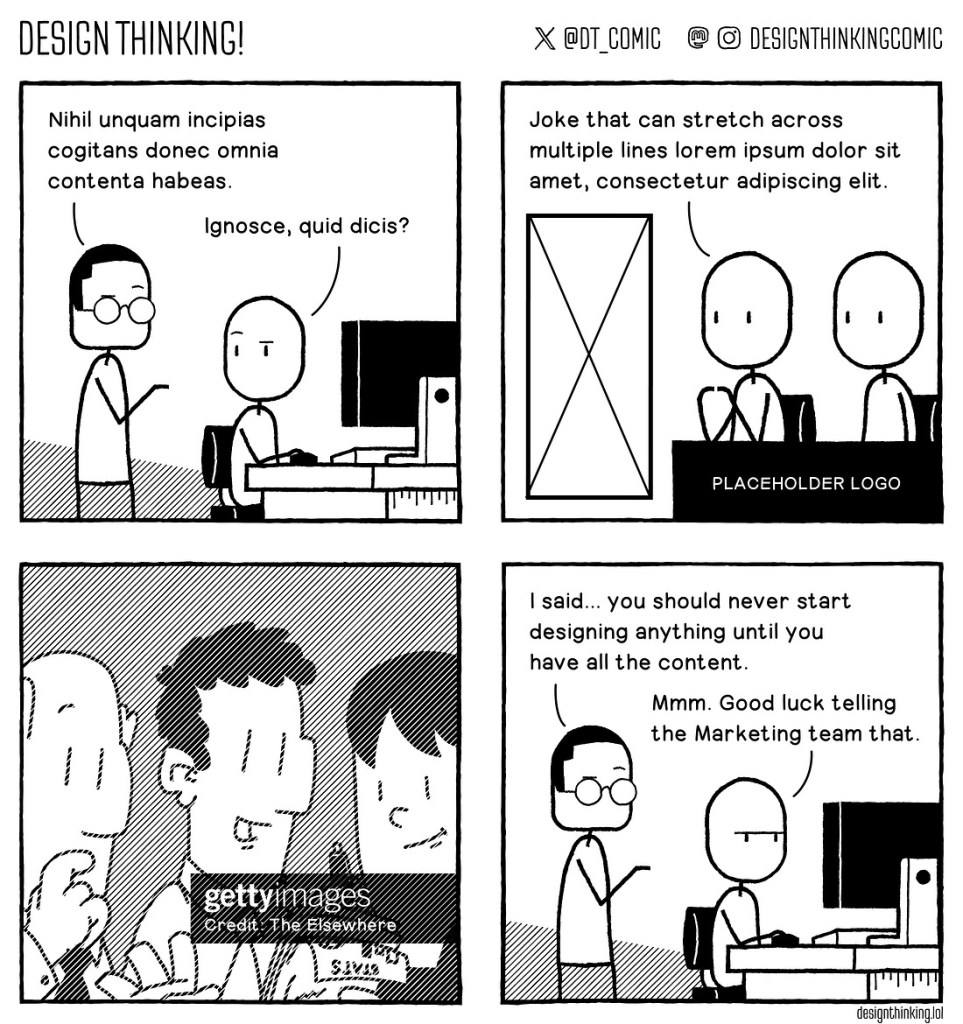
Saw this one and thought of the struggle to explain what content designers do, and why content first thinking can kinda be useful at times. A good example/explainer to share with doubters in future. Can’t remember seeing the argument made in such a convincing and punchy way before. Clever old designthinking.lol
Learn
Wikenigma – An encyclopaedia of the unknown
What a brilliant project. Such a wonderful collection of our ignorance, and the wonder, opportunity and humility that acknowledging it represents. I particularly like the Language > Etymology section (feels very theallusionist.org. And of course, one of my favourite unknowns, the placebo effect. That we don’t understand such a powerful and influential force within ourselves gives me such a lovely humble feeling. We’re just kids! Still trying to figure out the basics. A thoroughly Type 0 civilisation!
Think
↗ Record 1 memory daily.
A really lovely little project, and great way for a creative to show their ability to have ideas and make them happen. Feels like something that could/should have emerged from Russell’s Interesting book. All that said, I’m sad that I wouldn’t actually use a nice idea like this these days for privacy fears. Giving a random website data about myself along with an email address. Feels too much like volunteering info to datasets that theyseeyourphotos.com is warning about.
 Mathew Wilson – Documenteering